Technical SEO Services
Technical SEO Services —
Fix What Search Engines Cannot See
Your content might be excellent. Your backlinks might be strong. But if Google cannot properly crawl, render, and index your website, none of it matters.
Technical SEO is the infrastructure layer that determines whether your pages even have a chance to compete.
100% White-Hat
Deep Crawl Analysis
Core Web Vitals Expert
72%
of websites fail at least one critical technical SEO factor
30%
average organic traffic increase from technical optimization alone
40–60%
lower rankings for pages with unresolved technical errors
55.7%
of websites pass all three Core Web Vitals thresholds
What Is Technical SEO and Why Does It Determine Everything Else
Technical SEO is the practice of optimizing the systems that sit between your content and Google’s ability to find, understand, and rank it. It covers crawlability, indexation, site speed, Core Web Vitals, mobile performance, structured data, site architecture, internal linking, security, and rendering.
It is not the visible part of SEO. There are no blog posts or backlinks involved. But it is the part that makes every other investment work.
The data makes this clear. According to Semrush’s 2025 Website Health Benchmark Report, 72% of websites fail at least one critical technical SEO factor that directly impacts crawlability, indexation, and search visibility. Research from RankTracker shows that pages with unresolved technical errors rank 40% to 60% lower than technically optimized equivalents, regardless of content quality.
That means a site with great content and strong backlinks can still lose to a technically sound competitor with weaker content. Technical SEO is not a supporting function. It is the foundation. Every dollar spent on content optimization, link building, and local SEO delivers diminished returns when the technical foundation is broken.
Backlinko’s 2025 analysis confirmed it directly: proper technical optimization increases organic traffic by 30% on average. Not from new content. Not from new links. Just from fixing what was already wrong.
The Foundation Effect
Content Optimization
Diminished returns without crawlability
Link Building
Wasted equity without proper indexation
Local SEO
Map pack depends on site health signals
Sources: Semrush 2025, RankTracker 2025, Backlinko 2025
Core Web Vitals and Page Speed Optimization
This is the section that separates technical SEO consultants who understand performance from those who run automated reports and call it a day. Core Web Vitals are Google’s primary framework for measuring real world page experience, and since the March 2026 core update, their weight in the ranking algorithm has been strengthened.
LCP
Largest Contentful Paint
Measures how long the largest visible element takes to render.
INP
Interaction to Next Paint
Measures responsiveness when users click, tap, or type.
CLS
Cumulative Layout Shift
Measures unexpected layout shifts as the page loads.
LCP — Loading Speed and Revenue Impact
LCP has the most direct revenue impact. A Google and Deloitte joint study found that a 0.1 second improvement in page load time increased retail conversion rates by 8.4% and average order value by 9.2%.
Vodafone Italy ran an A/B test on two identical pages. A 31% improvement in LCP was enough to drive 8% more sales. Renault measured 10 million visits across 33 countries and found that a one second LCP improvement correlated with a 14 point bounce rate drop and a 13% conversion lift.
For an e-commerce site generating $10 million annually, a 500ms improvement in load time translates to roughly $500,000 in recovered revenue, derived from aggregated A/B test data published by DigitalApplied in 2026.
8%
more sales — Vodafone
13%
conversion lift — Renault
23%
longer sessions — Tokopedia
28%
more organic traffic — Nykaa
INP — Responsiveness Matters More Than Ever
INP replaced First Input Delay (FID) as a Core Web Vital in March 2024. It measures how quickly your page responds when a user interacts with it — clicking a button, tapping a menu, selecting a form field.
INP is stricter than FID. FID only measured the first interaction. INP measures every interaction on the page and reports the worst one. Sites that passed FID may fail INP because a slow dropdown, a lagging accordion, or a sluggish form input gets flagged.
Globally, 87.1% of web origins pass INP as of January 2026 CrUX data. But the 12.9% failing includes a disproportionate share of JavaScript heavy sites built on React, Angular, and Vue without server side rendering.
Interaction Timeline
150ms — Good
Under 200ms threshold
Over 500ms — Poor
CLS — Visual Stability Drives Revenue
CLS measures unexpected layout shifts — when elements on the page move around as it loads. Text jumping down when an image loads above it. A button shifting right as an ad slot renders. These shifts frustrate users and cause misclicks.
Google’s own case study documented that when iCook improved CLS by just 15%, ad revenue increased by 10%. Tokopedia reduced LCP by 55% and saw a 23% increase in average session duration.
Before (CLS: 0.38)
After (CLS: 0.02)
+10%
ad revenue — iCook
+23%
session time — Tokopedia
The Current State of Core Web Vitals (2026 Data)
As of January 2026, only 55.7% of all web origins globally pass all three Core Web Vitals thresholds simultaneously, based on CrUX data analyzed by Whitehat SEO.
On mobile, only 42% pass all three metrics. Desktop pass rates sit higher at 63%. The mobile gap is where the revenue impact concentrates because mobile accounts for over 60% of all web traffic and over 75% in local, retail, and consumer facing categories.
HubSpot’s 2026 study found that an extra 2 seconds of load time increases bounce rate by 103%. Pages loading within 2 seconds show a 9% bounce rate. Pages taking 5 seconds reach 38%.
Google’s own research confirms that 53% of mobile users abandon sites taking longer than 3 seconds to load. Addy Osmani, who led Core Web Vitals development at Google for over a decade, described the scale: the CWV program saved Chrome users an estimated 30,000 years of waiting time in 2024 alone.
What We Fix in Core Web Vitals Optimization
Every CWV issue has a specific technical cause and a specific fix. We do not run PageSpeed Insights and hand you a screenshot. We diagnose using real field data from CrUX and lab data from Lighthouse, then implement fixes directly.
LCP Fixes
- Image compression (WebP/AVIF)
- Critical CSS inlining
- Font preloading
- Server response optimization
- Render blocking removal
- Lazy loading below fold
- CDN configuration
INP Fixes
- JS execution reduction
- Main thread optimization
- Code splitting
- Deferring non-critical JS
- Debouncing event handlers
- DOM size reduction
- Eliminating long tasks
CLS Fixes
- Explicit image dimensions
- Font preloading
- Ad slot space reservation
- Late-injection prevention
- CSS content-visibility
- Embed size declarations
Improvements appear in Google Search Console within four to six weeks because CrUX uses a rolling 28 day data window.
Real Results — Our Own Site
seoinlaca.com PageSpeed Insights — same day, before and after optimization
Before Optimization
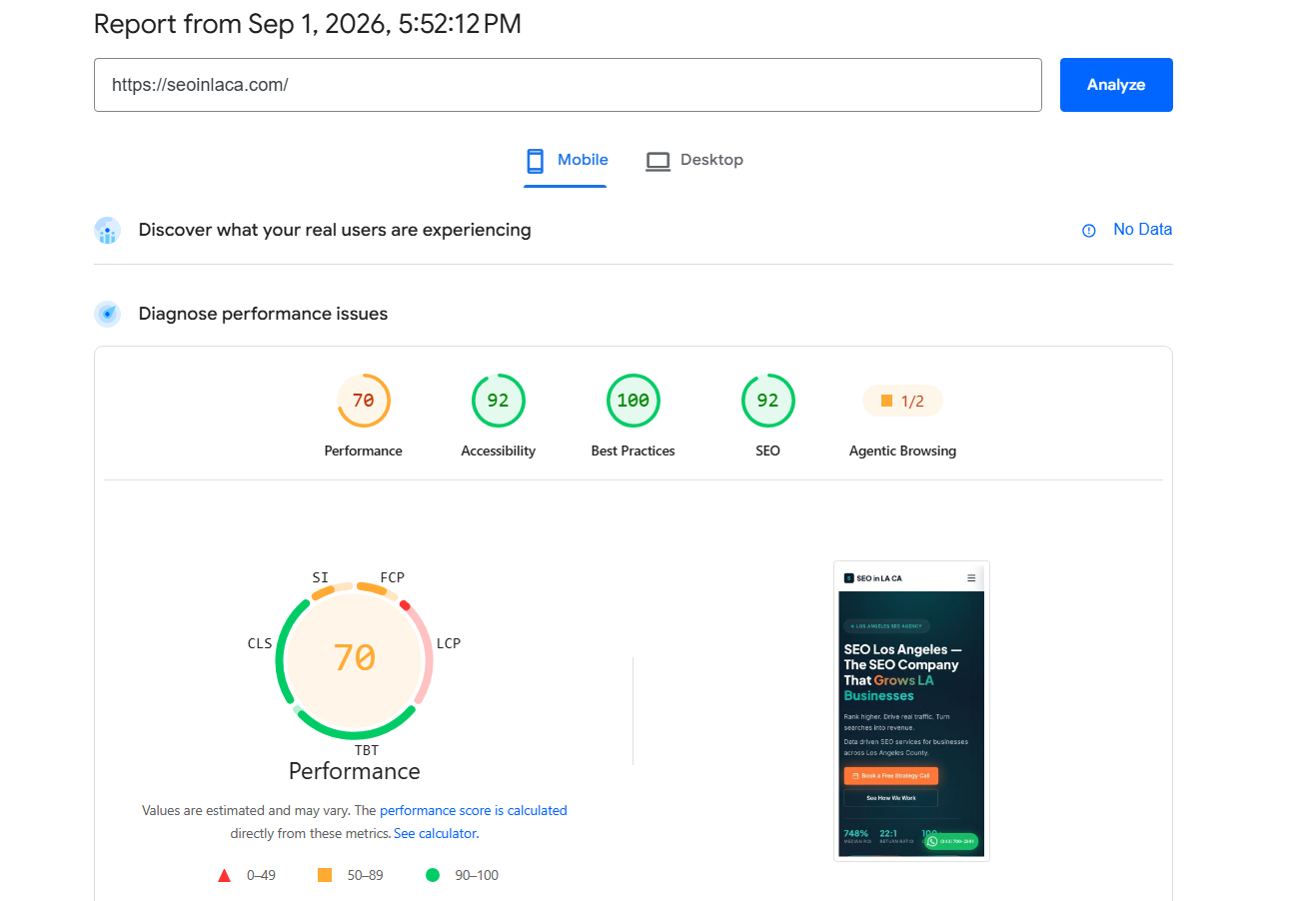
70
Performance
92
Accessibility
100
Best Practices
92
SEO
After Optimization
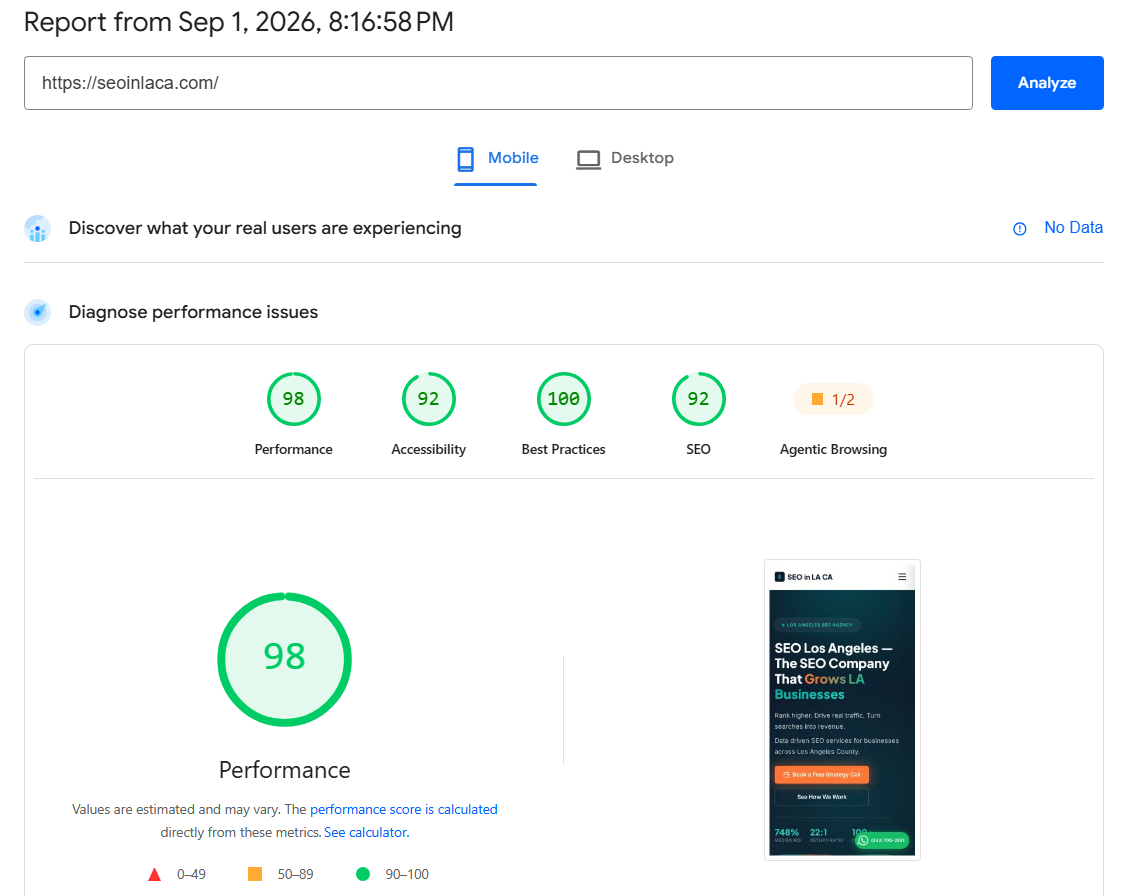
98
Performance
92
Accessibility
100
Best Practices
92
SEO
Performance Score: 70 → 98 — a 40% improvement on mobile
Font optimization, render-blocking removal, deferred JavaScript, CSS animation replacement, and critical path restructuring
Crawlability and Indexation — The Prerequisites for Ranking
A page that cannot be crawled cannot be indexed. A page that cannot be indexed cannot rank. And in 2026, a page that is not indexed cannot be cited by AI systems either.
This is where technical SEO begins. Before we touch content, before we think about keywords, we make sure Google can actually find and process your pages.
The 2026 data from BloggersIdeas, drawn from the Web Almanac and Ahrefs research, shows just how widespread crawlability issues are.
RankTracker’s research found that fixing crawl errors alone increases organic traffic by 20% to 35% on average. And proper site structure can reduce crawl budget waste by 70%.
95.2%
of websites have redirect problems (chains, loops, or unnecessary 3XX responses)
59.5%
are missing H1 tags on key pages
80.4%
are missing alt attributes on images
What We Audit and Fix
Every SEO audit we conduct starts with a full crawl of your site to map these issues, prioritize them by impact, and fix them systematically.
Site Architecture and Internal Linking
Your site’s structure determines what Google finds, how quickly it finds it, and how much authority each page receives. A poorly structured site buries important pages. A well structured site puts them within reach.
The industry standard is clear: every important page should be accessible within three clicks of the homepage. Search Engine Journal’s analysis confirms that Google treats deeper pages as less important, resulting in lower crawl frequency and weaker link equity.
And it is not just Google. Discovered Labs’ 2026 analysis found that AI retrieval systems apply the same logic. Site architecture is now an AI visibility lever, not just a traditional SEO one.
Internal linking is the mechanism that makes architecture work. According to Upward Engine’s 2026 research, strategic internal linking can boost search rankings by up to 40%, improve crawl efficiency by 40% to 70%, and drive traffic increases of 31% or more within a few months.
Ideal Site Hierarchy
Homepage
Services
Industries
Locations
Local SEO
Tech SEO
On-Page
Dentists
Law Firms
Beverly Hills
Santa Monica
40%
ranking boost from linking
70%
less crawl budget waste
Flat Architecture
Critical pages within two to three clicks of the homepage
Topic Clusters
Related content grouped under hub pages for topical authority
Internal Link Strategy
PageRank distributed intentionally toward highest value pages
Breadcrumb Navigation
BreadcrumbList schema for crawlers and users
URL Structure
Logical, keyword informed, consistently formatted
Orphan Page Resolution
Every important page reachable via internal links
For e-commerce sites with thousands of product pages, architecture is especially critical. Without intentional structure, product pages get buried four, five, or six levels deep — effectively invisible to both crawlers and users.
Mobile First Optimization
Google uses the mobile version of your website for all crawling, indexing, and ranking. Not some of the time. All of the time. Since July 5, 2024, Google has crawled every website exclusively with its mobile smartphone crawler.
If content, structured data, or links exist only on your desktop version and not on mobile, Google does not see them. Period.
53% of mobile users abandon sites that take longer than 3 seconds to load. For LA businesses serving local customers, where the majority of searches happen on phones, mobile performance is the primary concern.
60–64%
of global web traffic is mobile
95.4%
Google's mobile search market share
75%+
mobile traffic in local & retail
53%
abandon sites > 3s load time
What We Optimize
- Responsive design
- Mobile page speed
- Touch target sizing
- Viewport config
- Mobile CWV testing
- Content parity
- Mobile usability fixes
Schema Markup and Structured Data Implementation
Schema markup is no longer just about triggering star ratings in search results. In 2026, it is the technical layer that determines whether your content gets cited by AI systems.
Sites with properly implemented structured data see click through rate improvements of 20% to 35% compared to standard listings. Google’s case studies found that pages displaying as rich results saw an 82% higher CTR versus non rich result pages.
Content with proper schema markup has a 2.5 times higher chance of appearing in AI generated answers. Sites with complete schema implementation see up to 40% more AI Overview appearances. And 71% of pages cited by ChatGPT utilize schema markup.
Rich Result Preview
seoinlaca.com › services
SEO Services in Los Angeles | SEO in LA CA
Expert SEO agency serving Los Angeles businesses. Technical SEO, local SEO, on-page optimization…
People also ask
How much does SEO cost in LA?
How long to rank on page 1?
What is technical SEO?
82%
higher CTR for rich results
2.5x
more likely in AI answers
71%
of ChatGPT-cited pages use schema
40%
more AI Overview appearances
Schema Types We Implement
Organization
Brand identity and Knowledge Graph
LocalBusiness
Address, hours, service area for local SEO
Article / BlogPosting
Author attribution and publish dates
Product
Pricing, availability, reviews for e-commerce
Service
Provider and area served
BreadcrumbList
Navigation hierarchy
FAQPage
Readable by AI systems
SameAs
Social profiles and Knowledge Graph links
All implementation in JSON-LD, the only format Google recommends. We validate every schema deployment through Google’s Rich Results Test and monitor performance through Search Console’s Enhancement reports.
HTTPS, Security, and Technical Trust Signals
HTTPS is not a competitive advantage in 2026. It is a baseline requirement. Sites without it are actively penalized in user trust, search visibility, and conversion rates.
According to W3Techs’ January 2026 data, 92.6% of the top 100,000 websites use HTTPS by default. Chrome, which controls over 65% of the global browser market, displays a “Not Secure” warning on every HTTP page. TheStacc’s 2026 analysis found that 64% of users leave immediately after seeing that warning.
For law firms, healthcare providers, and any business collecting user data through contact forms, HTTPS is also a compliance and liability issue.
What We Configure
- SSL/TLS certificate installation and renewal monitoring
- HTTP to HTTPS migration with proper 301 redirect mapping
- Mixed content resolution
- HSTS header implementation
- Security header configuration (CSP, X-Frame-Options)
- Vulnerability scanning and malware monitoring
JavaScript SEO and Rendering Optimization
This is the technical SEO challenge that has changed the most in 2026, and the one most agencies still get wrong.
Google can render JavaScript. A Vercel and MERJ study found 100% of indexable HTML pages were rendered, with a median crawl to render gap of just 10 seconds. But Google’s rendering is two phase: first it fetches the raw HTML, then queues the page for JavaScript rendering in a separate pass. That second phase can be delayed by hours, days, or weeks.
The Growth Terminal’s March 2026 analysis found crawl delays hit 40% longer for JavaScript heavy sites. Search Console data showed that 80% of Single Page Applications have crawl budget waste.
JS Rendering Pipeline
The AI Crawler Problem
AI crawlers — GPTBot, ClaudeBot, PerplexityBot, OAI-SearchBot — do not render JavaScript at all. They read raw HTML as plain text. If your content only appears after JavaScript loads, it is invisible to every AI search system on the market.
ChatGPT accounts for 92.4% of standalone LLM referral traffic. A page that only exists after hydration forfeits the single largest AI referral channel.
Google’s own documentation, updated March 2026, states it clearly: “Server side or pre rendering is still a great idea because it makes your website faster for users and crawlers, and not all bots can run JavaScript.”
Our Approach
We audit JavaScript rendering using Search Console’s URL Inspection tool, comparing raw HTML against rendered HTML. We identify content, links, meta tags, and structured data that only appear post rendering and recommend migration to SSR, SSG, or hybrid approaches depending on your platform.
Critical content, navigation, canonical tags, and structured data belong in the initial HTML. Interactive UI components can remain client side. The distinction matters, and most development teams do not draw it correctly without technical SEO guidance.
Our Technical SEO Audit Process
Every technical SEO engagement begins with a comprehensive audit. Not an automated report. A manual, expert led analysis of your site’s technical health, conducted by technical SEO specialists who understand both the engineering and the search strategy.
What We Examine
- Full site crawl analysis
- Indexation review via Google Search Console
- Core Web Vitals (CrUX field + Lighthouse lab data)
- Mobile usability audit
- Site architecture and crawl depth mapping
- Internal linking analysis and PageRank flow
- Redirect audit (chains, loops, 3XX)
- Duplicate content and canonical review
- Schema markup validation
- JavaScript rendering comparison
- HTTPS and security header review
- Robots.txt and XML sitemap accuracy
- Page speed with prioritized recommendations
- Log file analysis (where available)
What You Receive
A prioritized, actionable document. Not a 200 page PDF of automated warnings. Every issue is categorized by severity:
Each issue is mapped to its expected traffic and revenue impact, paired with a specific fix recommendation.
You also receive a 90 day implementation roadmap that sequences fixes in the order that delivers the fastest, highest impact results first.
For a full overview of our audit beyond technical factors, see our dedicated audit page.
Technical SEO for Los Angeles Industries
Technical SEO requirements vary by industry. A five page law firm website has different needs than a 10,000 SKU e-commerce store. A dental practice with three locations has different schema requirements than a SaaS company serving international markets.
Healthcare & Legal (YMYL)
Google applies heightened scrutiny to Your Money or Your Life content. Author schema, organization credentials, HTTPS, and publication dates carry more weight. Technical errors on YMYL sites cause disproportionate ranking drops.
E-Commerce
Large catalogs create crawl budget challenges. Faceted navigation generates duplicate URLs. Category pages cannibalize product pages. We solve these through canonicalization, crawl budget management, and architecture optimization designed for scale.
SaaS & Tech
JavaScript rendering is almost always the primary issue. SPAs, client side routing, and dynamic content create crawlability problems requiring SSR/SSG. International SEO with proper hreflang is often a factor for global SaaS brands.
Local Service Businesses
Google Business Profile optimization is critical, but your site's technical health directly affects map pack visibility. For businesses across LA County, technical SEO is the invisible differentiator.
Frequently Asked Questions About Technical SEO
01 What is technical SEO?
Technical SEO is the process of optimizing the infrastructure of your website so that search engines can efficiently crawl, render, index, and rank your pages. It covers site speed, Core Web Vitals, crawlability, indexation, mobile performance, site architecture, internal linking, structured data, HTTPS security, and JavaScript rendering. While on page SEO focuses on content and keywords, and off page SEO focuses on backlinks and authority, technical SEO focuses on the systems that make both of those investments effective.
02 Why is technical SEO important?
Because 72% of websites fail at least one critical technical SEO factor (Semrush, 2025), and pages with technical errors rank 40% to 60% lower than optimized equivalents regardless of content quality. Technical issues silently prevent your pages from being discovered, indexed, or ranked. Fixing them increases organic traffic by 30% on average (Backlinko). No amount of content or link building compensates for a broken technical foundation.
03 What are Core Web Vitals and do they affect rankings?
Core Web Vitals are three Google metrics measuring real user experience: LCP (loading speed, threshold under 2.5 seconds), INP (responsiveness, under 200 milliseconds), and CLS (visual stability, under 0.1). They are a confirmed ranking signal, and the March 2026 core update strengthened their weight. Only 42% of mobile sites currently pass all three. Sites that achieve good scores see conversion improvements of 15% to 30% and significantly lower bounce rates.
04 How long does a technical SEO audit take?
A comprehensive technical audit typically takes one to two weeks depending on site size and complexity. Small business sites (under 100 pages) are usually completed within one week. Larger sites, e-commerce stores with thousands of products, or sites with complex JavaScript rendering require more time. You receive a prioritized roadmap with clear fix recommendations and expected impact estimates.
05 How much do technical SEO services cost in Los Angeles?
Technical SEO services in Los Angeles typically range from $1,000 to $6,000+ depending on scope. A one time technical audit ranges from $500 to $4,000. Ongoing technical SEO management is usually part of a comprehensive SEO campaign starting at $2,500 per month. The cost depends on site size, platform complexity, and the severity of existing issues.
06 Can technical SEO fix a site that is not ranking despite good content?
Yes, and this is one of the most common scenarios we encounter. A site can have well written, keyword targeted content and still fail to rank because Google cannot crawl it properly, key pages are not indexed, the site loads too slowly, or the architecture buries important pages too deep. Technical SEO removes these invisible barriers. RankTracker data shows that fixing crawl errors alone increases organic traffic by 20% to 35%.
07 Do I need technical SEO if my site is built on WordPress or Shopify?
Yes. Every platform has technical SEO challenges. WordPress sites commonly suffer from plugin bloat, duplicate content from tag and category archives, and poor default schema implementation. Shopify sites face limitations with URL structure, pagination handling, and faceted navigation. Platform choice establishes a baseline, but implementation quality determines your actual technical health. We work with WordPress, Shopify, Webflow, custom builds, and every major CMS.
08 How does technical SEO affect AI search visibility?
Technical SEO is now a direct factor in AI search visibility. Schema markup increases AI answer citation probability by 2.5 times. 71% of pages cited by ChatGPT use structured data. AI crawlers (GPTBot, ClaudeBot, PerplexityBot) do not execute JavaScript, so content must exist in the initial HTML to be visible. Proper GEO and AI SEO starts with a technically sound foundation: clean HTML, structured data, clear entity markup, and fast, crawlable pages.
Your Website's Technical Health Is Either Helping You Rank or Silently Holding You Back
72% of websites have critical technical issues they do not know about. Our technical SEO audit will show you exactly what is broken, what it is costing you, and how to fix it — prioritized by impact.